European Freight Market Update Live
Flexport's 9 June 2026 European market update: trade lane news, ocean and air capacity, rate movements, and the regulations worth planning around.
Couldn't load video
European Freight Market Update Live
Speaker 1: Hello, everyone, and thank you for attending today's European Freight Market Update. My name is Janik, and I'm a senior manager ocean freight for Germany at Flexport.
Speaker 1: Before we dive in, we'll go over a few quick housekeeping notes to help everyone get oriented.
Speaker 1: On your screen, you would see a sidebar to the right of the main stage where you can submit questions. At the end of the presentation, we will host the q and a and answer a few audience questions. So be sure you get your questions in early.
Speaker 1: In the same sidebar, you will see a tab labeled with docs. This is where you can find a download where you can download a copy of today's slides.
Speaker 1: Now a brief legal note. Please keep in mind that all the information provided in this session is based on the situation at this current time and may not be customized to your specific business requirements. We always recommend reaching out to a Flexport expert to discuss your particular situation.
Speaker 1: Before I present before I present our first speaker, let's go through today's agenda.
Speaker 1: We are going to share the latest updates on European's air and ocean market, review key customs developments, and provide recommendations to keep your freight moving. Now let's kick it off with air freight and Arno, our first speaker.
Speaker 2: Hello, everyone. My name is Arno. I'm the head of air freight for the German speaking markets as well as the Nordics.
Speaker 2: Welcoming you also to the freight market update.
Speaker 2: I'm now looking at what's going on in air freight globally and in particular on the Asia and to Europe trade.
Speaker 2: So let's kick it off and first look on the comparison versus last year. So overall, we see still a very robust airfreight market.
Speaker 2: Demand is strong and we see continuous volume growth over the year. We are now at four percent year to date and also the rates are leveled up by thirty five percent versus last year.
Speaker 2: On the Asia to Europe route, we see even more demand as well as like more accelerated rate levels.
Speaker 2: When we go and look into like the last two weeks, we see that the capacity remained flat. So I will look into that a bit on the next slide, but basically there was no massive change in capacity. We see that the volumes dropped over the past weeks, that's the usual breathing room we have in the time of the year with all the national holidays and bank holidays globally. We had EAT in the Middle East which is like in a bit of more extended holiday period, but we here see also that the Asia to Europe volumes remained quite strong with only a two percent dip and on the other hand we see that even though that the volumes dropped we see that rates stayed firm and even increased by two and one percent on the Asia into Europe route.
Speaker 2: What is to expect in June like on the on the short term? We hear from customers and we see it also in the booking intakes that we have a strong quarter end.
Speaker 2: That is expected.
Speaker 2: Customers explained it partially with that they had been very defensive in the ordering during March and April and now catching up for the quarter.
Speaker 2: But we also see, and I will talk to about that a bit later, that we expect the rush in e commerce shipments on the Asia to Europe trade due to the upcoming changes in the customs ruling for de minimis into the EU.
Speaker 2: So even though we all feel that the market is or we feel more comfortable in the new normal what the market is right now and that the situation is relaxing also in terms of the Middle East crisis, we don't expect that the rates will drop as fast or as much as we all would love to see.
Speaker 2: And here also fuel is another trigger point which then has an influence on the cost structure of the carriers and then on the pass through all in air freight rate.
Speaker 2: When we go to the next slide, we have the big three I call it, so the big three topics that keep us awake at night in the past weeks and months. So first of all we have the Middle East carrier capacity.
Speaker 2: We see Emirates and Qatar Airways operate at seventy five percent of pre war capacity, Egypt is at sixty.
Speaker 2: Qatar and it as well as Egypt mentioned that they target the capacity being back to normal by mid of June.
Speaker 2: It's still very relevant that the Middle Eastern carriers are coming back into the play with full capacity as they are very very strong especially in the Asia into Europe route but they're also in the connections from Asia into Africa as a as big network carriers.
Speaker 2: Also worth to mention is like if this conflict is not getting resolved over over this year, this will also have like an ongoing big impact on capacity because Emirates and Qatar are also the ones who have the biggest order books for freighters and Emirates is the one who will still receive like many seven triple seven freighters within this year adding more capacity to their fleet and also increase than the the overall share of capacity.
Speaker 2: When it comes to jet fuel, we are now forty percent lower than what we saw in the March peak.
Speaker 2: The jet fuel prices have stabilized, but we still don't see the drops as fast as we see it in the crude oil price. This has to do with refinery capacity and also a strong imbalance in where jet fuel is available and whereas refinery capacity available. So in Europe for example we import a big batch of jet fuel meanwhile from the US which is a special ruling because the jet fuel standards for the European Union are much stricter than what you have for the US and now European carriers are allowed to use the US jet fuel to compensate for what's missing from the Middle East. Then the third big element is the Europe e commerce reset.
Speaker 2: Effective first of July, we will have three euros per item on a commercial invoice that has been where e commerce has been taxed. So what we expect here is that and we see it already that e commerce players increased volumes prior this ruling. We saw that also when this was implemented into the in the US and in a different manner but we saw here also that there was a pre rush putting more pressure on capacity and increasing demand on the Asia into Europe lane.
Speaker 2: So on the next slide, I prepared two scenarios for you guys. So we have the the scenario a, which I call the relief window.
Speaker 2: Here we expect that after the the pre rush of the the e commerce shippers will stop first of July and then based on what different studies are forecasting fifteen to twenty percent of volumes would drop which is mainly then also coming from China into the European Union.
Speaker 2: Also that capacity of the Middle East carrier stabilized and they reached their recovery targets and more capacity comes in the market. So then we would we would see that spot rates especially out of APAC would soften across July and August prior Q4, or prior to the traditional peak season.
Speaker 2: We highly recommend them if that kicks in that customers should take advantage of the spot market where we then would see a pretty significant gap between the BSA rates or fixed capacity rates and the day price and you could make good deals on in that scenario. Scenario B not as bright as scenario A. Here we see okay the e commerce players will continue to ship they've they found the right configuration of of their document customs documentation will the the drop will will come slower open capacity then will also will be absorbed by AI and tech hardware shippers, which we all see see as the next biggest commodity in terms of growth versus e commerce. And and then a combination of like Middle Eastern crisis will continue or further escalate that we would then expect that we stay basically in our new normal where rates hold firm and further increase going into Q4.
Speaker 2: These are the two scenarios we think the scenario A is more likely to happen than scenario B, but you have to be prepared for both scenarios.
Speaker 2: When we go on my last slide, the recommendations, so in terms of also monitoring the markets closely monitor the jet fuel prices.
Speaker 2: If you have options or you have forwarders who can support you with that, check what are the carrier load factors. If the carrier load factors are going below eighty percent, then you see that it's becoming more a biased market on a certain lane with soft spot market. Try to get this kind of information.
Speaker 2: Focus already on the scenario planning for Q4. So what is my own forecast for Q4 in terms of airfreight?
Speaker 2: Will I have to shift airfreight? Will I have to shift ocean freight to airfreight because of ongoing the capacity crunch on in the ocean side. When I need to do that, should I do it now, ideally you do you you already do this pre planning for Q4 and also for the end of Q3 now.
Speaker 2: And then check, of course, what is your tender ability that you don't ask for rates when the market is at peak.
Speaker 2: But it's like a given for all the the procurement folks in this call.
Speaker 2: Last but not least, consider alternative solutions. Sea Air is within the high market still a good product. We have a flex border solution going via Los Angeles, but we also have from the subcontinent a good rate solution where you can save time and money versus time versus ocean freight and money versus air freight. So reach out to your Flexbox account executives and ask for these opportunities to save either money or speed up ocean freight shipments.
Speaker 2: And now I hand it over back to Janik who is giving you the the best of the ocean side.
Speaker 1: Thanks a lot, Arno.
Speaker 1: Before we kick it off with the ocean part, we have a question prepared for the audience.
Speaker 1: We would like to see everyone's party on the on the question that you see here. It's it's basically about your your booking behavior right now.
Speaker 1: Four different options. The first one is I'm seeing an increased demand. Second answer option is demand is stable. I'm increasing bookings to secure space.
Speaker 1: The third one is see stable to low demand and I book less.
Speaker 1: And the third option the fourth option would be demand is stable. I'm just boosting stock levels. So curious to see what everyone is voting for.
Speaker 1: Give it a couple more seconds here.
Speaker 1: Okay. We have roughly fifty votes in.
Speaker 1: Alright.
Speaker 1: So the majority is seeing an increased demand.
Speaker 1: Roughly forty percent here.
Speaker 1: And pretty much tied on the second place is demand is stable.
Speaker 1: I'm securing space or I'm booking I'm booking less.
Speaker 1: But, yeah, I mean, the the increased demand is what what actually lead us to the next slide. The in this case, Fiskarsen development. So thanks everyone for the participation and and kick it off.
Speaker 1: On the right, you can see the SCFI development.
Speaker 1: As usual, we compare the last three years. So you have twenty twenty four and the dark blue one, twenty twenty five in red, and green is the actual one, twenty twenty six. And we can clearly see a pattern after after the Labor Days in in May that the SCFI is going up.
Speaker 1: For this week, we have two thousand six hundred and five US dollar per TEU to North Europe and three thousand eight hundred to the MET Mediterranean.
Speaker 1: So this is a eighty five percent increase on North Europe and thirty four percent to the MET. So since the beginning of April. So definitely shows a pattern for the period after the Labor Day.
Speaker 1: Now if we check on the reasons for those increases, we see see multiple events.
Speaker 1: First, and I need to be honest here, I will probably never get used to this, but the Christmas season is starting. So commodities with a specific production and availability date need to be shipped out.
Speaker 1: Additionally, the Middle East crisis is causing consumers to shift travel budgets into consumer goods. We saw this incredibly heavy during the COVID pandemic.
Speaker 1: Clearly, we are not we are not at those levels yet, but it's something that we see.
Speaker 1: Also, we recognize that Amazon changed the the date for the prime days.
Speaker 1: So ocean shipments would most likely not arrive in time for that, but definitely new bookings for for restockings that happened earlier.
Speaker 1: Yeah. Let's switch to the next slide and also check-in detail how this global container demand is developing.
Speaker 1: So c this latest c intelligence data is showing that already in April, the global container demand was growing by four point three percent year over year. If we strip out North America and the Gulf region disrupted by by the Strait of Hormuz situation, the rest of the world grew more than ten percent year over year. Ten point three percent means that April this year set an all time record with sixteen point two million TEU loaded in a single month. That's clearly underlying the demand strength and by every available slot gets absorbed in the idle fleet. So let's say open capacity is on a very low level for for quite a time right now.
Speaker 1: If we move on, we can have a look into another event that keeps everyone busy, especially when it comes to freight forwarding, the current situation in the Strait of Hormuz.
Speaker 1: So latest with the attack on the MSC owned vessel, MSC Zariska, which is a three thousand nine hundred TEU vessel that was located on the far north in the Persian Gulf, so pretty much far away from the Strait of Hormuz itself, container vessel transits through the Strait has come to zero. The volume impact, which followed on the conflict beginning of March, is roughly sitting at at seven hundred thousand TEU that disappeared from the market.
Speaker 1: And in April, only twenty percent twenty one percent of that recovered.
Speaker 1: Structure reroutings are in place in order to avoid the passage.
Speaker 1: And on the geopolitical outlook, the ongoing conflict makes a near term change of this status and the situation very unlikely. And this week or earlier this weekend, the Yemenidi rebels Houthis have claimed further attacks on Israel, which adds another layer of uncertainty when it comes to to how and when this situation will be resolved.
Speaker 1: In terms of disruptions for businesses not directly linked to the Middle East traffic, we continue with the next slide and have a closer look to what happened to the to the oil prices, to the bunker prices.
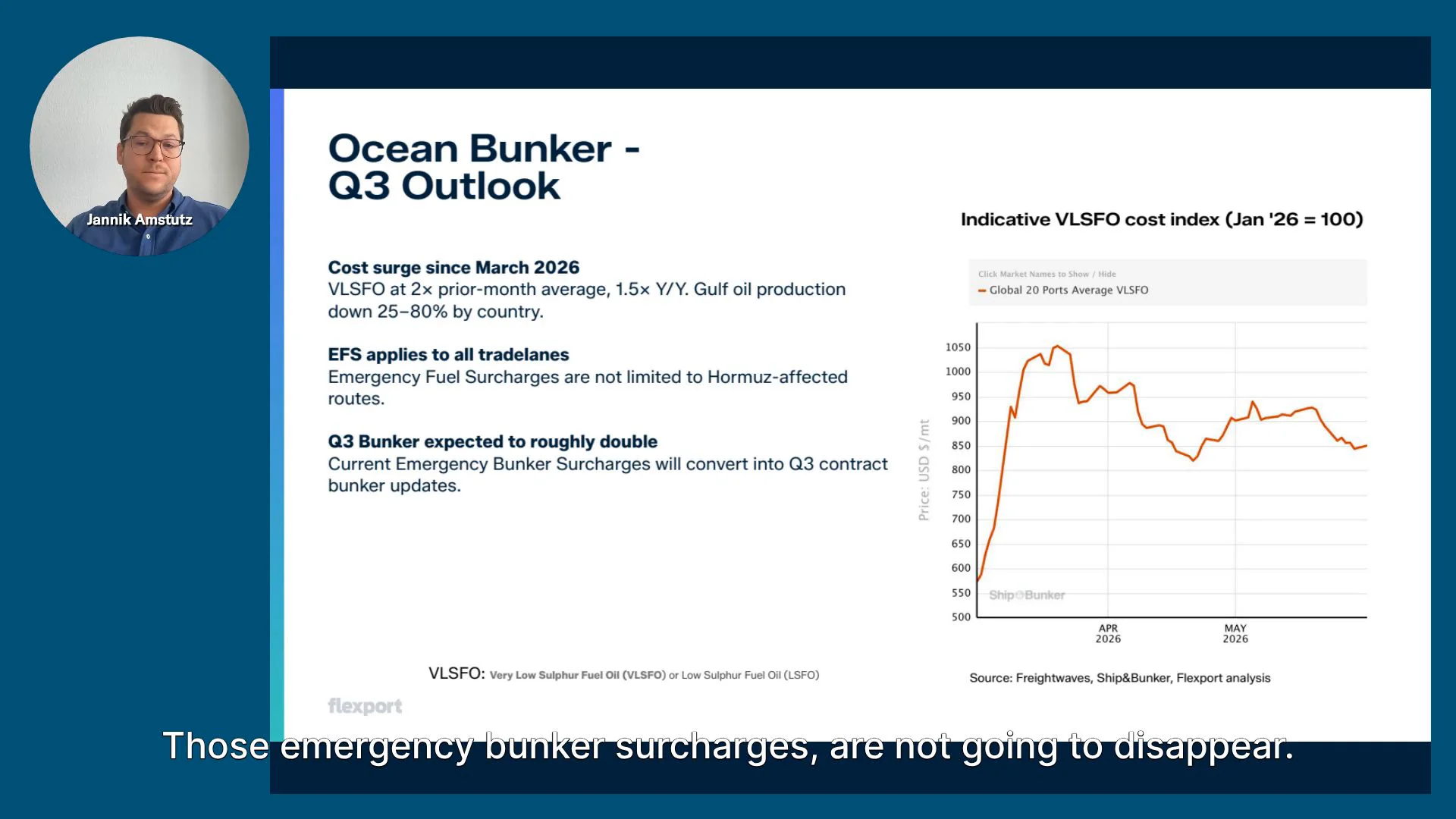
Speaker 1: So the VLSFO, which stands for very low sulfur, basically, oil disruptions and the oil price run as roughly double its prior month average and about one point five times year over year.
Speaker 1: Additionally to that, the oil production in the Gulf States is down. Depending on which country you look at, it's down twenty five to a maximum of eighty percent depending on the country itself. The immediate consequence that we saw in March was the implementation of of emergency fuel surcharges.
Speaker 1: And they have not been limited to to routings in regards to the Middle East, but to basically all the trades.
Speaker 1: Those emergency bunker surcharges are not going to disappear.
Speaker 1: They are going to convert mainly into the q three bunker updates. So the as the as the bunker levels for the second quarter have been announced slightly prior to the conflict in the Middle East.
Speaker 1: The levels for q three are going to rise.
Speaker 1: And based on the last three months of oil prices, in the picture on the right, you see the average on the global twenty ports.
Speaker 1: This is going to increase drastically.
Speaker 1: Now last, let's move to the next slide. What would we recommend to navigate your bookings in the current market? The first and overall recommendation is to secure the space. So book early. The space is tight.
Speaker 1: Make sure that your shipper meet the confirmed cargo ready dates. It's very important that, especially with production delays, export customs clearances, that the cargo ready dates are set exactly so you don't need to basically change them.
Speaker 1: Second, it might be helpful to build a transit buffer. Scalar reliability is still under pressure and also ports and intermodal connections in the hinterland are under pressure.
Speaker 1: Also, we see rollover ratios with the recent booking intake to increase.
Speaker 1: Third topic is, are you set at destination? So the higher volumes that are going to ship in the next weeks or also in the earlier weeks will, of course, increase the container flows.
Speaker 1: So it will be higher intermodal activity. The question is, does everyone have the warehouse capacity and also the unloading slits for for container in regards to everything that is currently on the water?
Speaker 1: Last option is consider LCL when FCL space is tight in peak seasons.
Speaker 1: To find FCL space might be might be difficult to short notice. So one option could be Flexport's ocean consolidated services, which offers LCL on fixed weekly sailings with full visibility. We have recently ran a supply chain optimization study for a major industrial importer in the DACH region and right sized their FCL to LCL mix lane by lane and solve peak season capacity constraints. So if FCL is really tightening up and if it's difficult to to find space, you can reach out to us and contact us.
Speaker 1: That's it for Ocean. And now I'm going to hand it over to Ruben for the latest updates on customs.
Speaker 3: Hi. Good afternoon, everyone. My name is Ruben Bell, and I'm principal at Flexport for customs business development. And I would like to take you through three customs topics today. First, I'll discuss US customs with an update of IEPA tariffs, refunds and new tariffs in the pipeline.
Speaker 3: Then I'll talk about EU customs and the removal of the de minimis duty exemption. And finally, I will discuss the EU deforestation regulation simplifications that were announced recently. Let's start with with US customs and the tariffs.
Speaker 3: If you import into the US or have watched the news, you know that since last year when Trump announced Liberation Day, you have been paying lot of tariffs for imports of of goods into into the US.
Speaker 3: And it's difficult to keep up with ever changing landscape of the tariffs due to the regulations that changed on a regular basis.
Speaker 3: In September, the US Supreme Court ruled that the IEPA tariffs that were introduced by Trump were actually unlawful. And that these tariffs that were paid had to be paid back to the importers. So refunds were on the table.
Speaker 3: To accommodate this, US customs has launched the Cape Portal for the refunds of these IEPA tariffs that went live on April twentieth of April this year.
Speaker 3: And since this date, many importers have been able to file refunds for these tariffs with customs in the US.
Speaker 3: So entries that have liquidated within eighty the last eighty days or have not yet liquidated, they are eligible for the Cape phase one.
Speaker 3: So it's possible to file refunds for for these entries, and we've actually been helping many clients to do so.
Speaker 3: Entries that are not within this time frame, it is possible to file a protest.
Speaker 3: And after some someday, it is no longer possible to file a protest or to use Cape phase one. And then it may be possible that your you lose the right to refund these these tariffs. So my tip is here.
Speaker 3: What should you do now? First, you need to check if you're if you have paid tariffs, but I think you will know if you have paid them.
Speaker 3: But you need to know how much you have paid. Then calculate your refund.
Speaker 3: You need to do an audit of your entries. We really recommend you to do that before you you file a refund claim in in the K Portal. Make sure that the entries that are filed with it with customs are correct.
Speaker 3: And my recommendation is to do it fast because before you know it, time this possibility may disappear. You never know what happens. After the US Supreme Court case, the section one twenty two tariffs were introduced with a ten percent tariff on the imports of goods regardless of the country of origin.
Speaker 3: And actually, the Court of International Trade in the US ruled on May seventh that these tariffs were also unlawful.
Speaker 3: But there's no US Supreme Court ruling yet, so it's not possible to file a refund in this at this stage.
Speaker 3: As I mentioned, Cape phase one is open. Cape phase two or later phases, there's no clarity yet. So we don't know what was going to happen with that.
Speaker 3: What I'll discuss now is the section three zero one forced labor determinations. So after the the US Supreme Court case where the tariffs were ruled unlawful, the US government has been looking to find ways to come up with a new set of tariffs to try a different angle that will be more difficult to to challenge in court.
Speaker 3: So they're looking at initiating more section three zero one tariffs. So this is a specific section within the US trade act.
Speaker 3: And this specific forced labor determinations that were announced by the US trade representative, they actually indicate that certain economies have failed to enforce a prohibition on forced labor through reasonable forced labor acts or that the enforcement of these acts were not efficient and is proposing a ten to twelve and a half percent tariff for these for the imports of products from these countries.
Speaker 3: What what what is interesting to note here, the section one twenty two tariffs are only temporary and will expire by the end of July. So it is actually our expectation that the investigations that are currently pending on this forced labor determinations may end at the end of July. So the section three zero one tariffs can be can be introduced when when when this happens. There are some proposed exemptions to these tariffs. So critical minerals, naturally available resources, section two thirty two goods, so that's aluminum and steel for which there are separate tariffs in place, chemical semiconductors and aircraft parts. Also, luckily USMCA qualifying goods and Dominican Republic and Central American Free Trade Agreement goods that are eligible are also exempted from these from these tariffs.
Speaker 3: And finally, there's a textile and apparel quota proposed, which allows a certain volume of apparel, let's say, t shirts or jeans to be imported into the US duty free under the section three zero one there. So potentially regular duties may still apply of course. And beyond this threshold, this ten percent or twelve point five percent rate will kick in.
Speaker 3: There's more news on the US customs front, namely a customs reform on foreign importers.
Speaker 3: So to target potential tariff circumvention and and fraud by foreign importers who want to, yeah, not pay or at least relief the the impact of the tariffs.
Speaker 3: The US has been looking to come up with plans to reform the customs legislation for these foreign importers. And many of course, many situations this takes place in a duty paid structure with foreign importers selling to US consumers or US companies.
Speaker 3: My colleague Marcus from the US, he actually hosted a whole webinar on this last Friday. So I really, if you're interested, recommend you to rewatch this.
Speaker 3: But in short, what it will entail, it's still a reform proposal. So it's not finalized yet, but expect regulations to follow in a couple of weeks, months time.
Speaker 3: But in short, foreign importers of record may be barred from using an informal entry. So this is an easier way of filing entries with customs.
Speaker 3: There are interest increases in the bond minimums. There's no option for filing continuous bonds. So that's a bond set for the whole year for foreign importers of record. So you have to file single entry bonds.
Speaker 3: All importers of record, so not only foreign importers of record actually need to hold some domestic US assets. There needs to be a disclosure on beneficial ownership and supply chain information.
Speaker 3: And finally, there are more strict requirements on the broker that you use for filing your entries into the US. So this needs to be a CTPAT certified broker. And if if a broker make makes mistakes and and and commits fraud as well, there are higher broker penalties for these brokers.
Speaker 3: Then I'll discuss EU customs. So and and as also we're already mentioned by by Arnaud, which is impacting the airspace at the moment.
Speaker 3: There are changes coming to to the EU de minimis for a duty exemption on small small parcels. So what do we have today? Today we have a duty exemption for goods under one hundred and fifty euros and they can enter the EU duty free.
Speaker 3: This may lead to many undervaluations of of exporters or importers trying to get the due customs value under this one hundred and fifty euros to save on duty cost. And this also leads to a high volume of low value packages for all the EU customs authorities. So the EU has come up with a proposal.
Speaker 3: So from the first of July, it's actually not a proposal, but it will really enter into force on the first of July.
Speaker 3: It will be a flat three euro duty rate per product category. So there will be a consolidation happening on a tariff classification line for parcels under one hundred fifty euros In the future, there may also be a two euro handling fee per declaration line. So combine that you may have a five euro duty plus handling fee per tariff classification for the imports.
Speaker 3: And note that these are transitional rates, while the EU is preparing in the broader customs reform package full tariffs from mid twenty twenty eight. So who is this impacting? This is really impacting e commerce platforms, marketplaces that will actually be considered the deemed importer of these goods and no longer the consumer that may act as importer for these purchases.
Speaker 3: So this will be non use sellers that heavily rely on the distance sales and the direct to consumer sales.
Speaker 3: These companies actually have already been set up for the one stop shop for that purposes. And now customs is following a similar similar route to to combat fraud here.
Speaker 3: What may help here actually is if you consider booking management solution that allows a further consolidation on the tariff line level, because whether it's a ten euro product or one hundred and forty euro product, a three euro duty rate will apply regardless. And if you help with consolidation on the line level, then it's possible to maybe reduce your duty impact for this temporary duty rate of three euros.
Speaker 3: And finally, will discuss the simplification package of the EU deforestation regulation.
Speaker 3: So in short, the deforestation regulation is a European law that requires certain commodities sold in the in the EU, such as cacao, kettle, coffee, palm oil, rubber, and derivative products that to be proven deforestation free and produced legally. And for this companies need to submit will need to submit due diligence statements. So DDS that include geolocation data of where the goods were grown or harvested.
Speaker 3: And recently, the EU came up with a simplification package that now will allow stable supply chains. So if you would import the same product from the same supplier and country for more than once, you could file an annual due diligence statements and no longer it is separate DDS per shipment. There will also be a downstream relief that only the first operator will file this full DDS and people later on in the chain can actually reference this statement.
Speaker 3: There's also been an adjustment to the product scope. So some goods like certain letters or waste or samples are out of the out of scope of the EUDR and some others are in like the palm oil derivatives, frozen kettle tongs, and and soluble coffee. What did not change? The application dates. So it is approaching. Please prepare because it is quite it's quite an impact.
Speaker 3: For large and medium operators, the thirtieth of December of this year, it will go live. And for small and micro operators, you have a bit of more time and it's next year at end of June.
Speaker 3: Enforcement is is quite substantial, there may be penalties of up to four percent of your EU turnover.
Speaker 3: And without a value a valid DDS, it may be possible that your customs entries will be blocked and will not be entered in allowed enter entrance into into the EU. So we really recommend you to rescreen the new HS exposure, map upstream suppliers for geolocation data, but also map your supply chain if you could benefit from this annual due diligence statements, and assign owner of this annual of an annual article twelve report where you report your your annual activities in in scope of the EU deforestation. If you have any questions about this, please feel free to reach out. We're here to help. And I'm now passing it back to to Janik, who will take you through the q and a.
Speaker 1: Thanks a lot, Ruben.
Speaker 1: And, yeah, to the audience, I think that we're, like, thirty minutes a lot of information overall, AeroOcean and and also customers. We have not received any questions till now.
Speaker 1: So we we would conclude it here.
Speaker 1: In case any questions come up, we are going to email everyone a link to the recording latest by tomorrow.
Speaker 1: Ruben said, if you have any question, reach out to your to your FlexPoint contact.
Speaker 1: And, yeah, thanks for joining. Have a great day, and looking forward to to see you again in in the July FMU. Thank you.
Related webinars
 Market UpdatesSeptember 10, 2026Register
North America Freight Market Update Live
Join Flexport experts live on September 10 for the North America Freight Market Update: trade lane news, ocean and air capacity, and where rates are heading.
 Market UpdatesSeptember 8, 2026Watch now
European Freight Market Update Live
Flexport's 8 September 2026 European market update: trade lane news, ocean and air capacity, rate movements, and the regulatory changes worth planning around.
 Market UpdatesAugust 13, 2026Watch now
North America Freight Market Update Live
Watch the on-demand August 2026 North America Freight Market Update, where Flexport experts cover trade lane news, ocean and air capacity, and rates.
- Market UpdatesJuly 16, 2026Watch now
North America Freight Market Update Live
Flexport's July 2026 North America market update: trade lane news, ocean and air capacity, and where rates were heading.