European Freight Market Update Live
Flexport's 14 July 2026 European market update: trade lane news, ocean and air capacity, rate movements, and the regulatory changes worth planning around.
Couldn't load video
European Freight Market Update Live
Speaker 1: Today, we'll have Franco Babinis, who who is taking care of our AI business with us. And we have Courtney, who is also with us connecting from the US and replacing who is already sick today and about to step down. So we have a full team energized, so we hope you are as well. Before we dive in, we go over a few housekeeping notes to keep everyone to help everyone to get oriented.
Speaker 1: So on your screen, you'll see a sidebar to the right of the main stage where you can submit your question. And at the end of the presentation, we'll host a q and a so that we can answer a few of your questions. So be sure to get your question in there early. In the same sidebar, you will see a tab that's called docs.
Speaker 1: This is where you can download a copy of today's slides.
Speaker 1: Alright.
Speaker 1: For now, we have a brief legal note. As usual, please keep in mind that all information we provide here today is based on the situation at this current time, and this may not be customized to your specific business requirements. We always recommend reaching out to a Flexport expert to discuss your particular situation.
Speaker 1: Good. That's the agenda and the hosts that I described a bit earlier, we will start with the guy in the middle, Franco, for your air markets update.
Speaker 2: Good afternoon, everyone. Thank you, Guillaume. Welcome to today's air freight market update. My name is Franco, and I'm a senior pricing associate for Central and South Europe.
Speaker 2: Let's dive into the air freight section. And as usual, let's start from an overview of what is going on in the market. So June was a pretty strong month. And as you can see, we had a thirty three percent increase in the rates compared to the same period last year as well as a nine percent increase in the volumes. And such growth, as we well know by now, was mainly driven by strong demand in AI infrastructure as well as semiconductor demand.
Speaker 2: And this is paired with still constrained capacity in the Middle East as Middle Eastern carriers are still operating at roughly seventy percent of their capacity compared to the pre conflict levels.
Speaker 2: On top of all of this, we still have very high jet fuel prices. Although the prices have actually reduced slightly in the last few weeks, we're still trying they're they're still trending roughly about thirty percent compare. If we have a look at first for spouts, so from Asia to Europe, we had a first for spouts, so from Asia to Europe. We had a pretty strong quarter end.
Speaker 2: However, since the last week of June, we've seen a turnaround in the market.
Speaker 2: And if you have a look at the last two rows of this table, although here we only have some marginal reductions in the volume and in the rates on the in the first week of July compared to the previous one, we've actually seen quite a significant drop in the volume from Hong Kong. And this drop is mostly related to the e commerce volume after the new regulation regarding the the minimists in Europe that came into effect from the first of July.
Speaker 2: And we have seen three weeks of consecutive volume drop. And on the first week of July only, we had a twelve percent decrease in the tonnage out of Hong Kong. So considering this, our expectation for July and August is that of a relatively stable market from China and Hong Kong, while on the other hand, we still expect very strong demand from Southeast Asia origins as well as Taiwan, mostly driven by AI related commodities and tech products.
Speaker 2: Now if we go to the next slide, we would like to propose, as we usually do, some scenario planning.
Speaker 2: And for our most regular viewers, if you remember from our last freight market update, my colleague Arno proposed a couple of scenarios for July, and we're pretty glad to say that our June prediction kind of came true because right at the moment, this is scenario a, which is a relief window, where we're seeing volumes dropping on the first response, especially from China and Hong Kong after the new regulations under the minimized ruling.
Speaker 2: And also with a stable capacity, we are seeing rates in the market, especially from China and Hong Kong, softening a bit, and we expect the same trend for the second half of July and August.
Speaker 2: However, we could still have a scenario b, which we decided to call early peak season, And the triggers for this scenario could be further escalations in the Middle East that, as we well know, could affect the available capacity as well as the jet fuel prices.
Speaker 2: Moreover, the air AI related commodities could take up the newly available space in the market, further putting pressure on the rates. And finally, the severe disruption that we're seeing on the ocean side could lead to more ocean to air conversion, further putting pressure on the markets.
Speaker 2: This scenario has a far less optimistic outlook compared to the scenario a.
Speaker 2: And in this case, we could see rates already begin an upward trend in early September rather than the traditional sort of the peak season towards early q four.
Speaker 2: Now before we conclude, as usual, we have a few recommendations.
Speaker 2: Please keep closely monitoring the jet fuel price, especially in light of the latest geopolitical developments.
Speaker 2: Moreover, consider reviewing the validity of your tenders and especially on those trade lanes where there's a supply and demand imbalance, you should take advantage of this in order to ensure the best commercial solution available at the time.
Speaker 2: Moreover, consider alternative solution whether you want to speed up your ocean shipments or you want to contain the cost of your air freight volume. Here at Flaxburg, we have several c a c r solutions that we can offer. So please do not hesitate to reach out to your FlexBar representative to discuss the best solution according to your needs.
Speaker 2: And finally, we suggest to kick off already now the q four forecasting and planning in order to avoid being unprepared and to stay ahead of all of the possible shifts in the market.
Speaker 2: Thank you for your attention. I will now leave the floor to Guillaume for the Ocean update.
Speaker 1: Thanks, Franco, for the updates. Alright. So let's dive into the Ocean one.
Speaker 1: So first slides, different month, same updates, quantum logistics.
Speaker 1: I try to put up a chronology about the different events regarding Arm was opening, Arm was closing, but I think if I had to do that and explaining and going through it, I wouldn't have enough time today. So, basically, let me just directly jump into the latest stories.
Speaker 1: Today, is no self passage in Hormuz.
Speaker 1: Military actions are taking place again, unfortunately, over Iran and and Hormuz strikes. Some vessels have been struck the last few days. This is why it broke. So the armo situation is now not set by such.
Speaker 1: Something that's evolved a bit more positively, let's say, the last few weeks was the right siege. So we probably the news that made the most noise the last couple of days were, like, Gemini and Maersk with HAPAG sending a new service back to the Red Sea. It has to be noted, though, that it's one service out of the total fleet that Dutch is priced. So in in the Mediterranean, which is something that Cino is already doing for the last couple of months on on those strides.
Speaker 1: But it's the first step on Gemini Alliance back to the Red Sea.
Speaker 1: If I go on the next slide, I want to dive a bit here. So what you can see is two snapshot that we took left one or most right one, Red Sea, where we looked at the number of container they said that passed through the blue square area over the last month. So, basically, between the first of January and the thirtieth of June, specifically.
Speaker 1: So if you look on the life side for August, we did remark a slide of taking term of container vessels crossing in June compared to to May and April.
Speaker 1: And, also, this number can be underestimated because there's a lot they said that cross the area. They are just switching up their AIS, so we don't see them counted.
Speaker 1: But still, even even the few increase that we are seeing, even though it can be underestimated, the total number were far from the precrisis situation, and the latest developments that we had the last the last week would probably display again a drop in term of of container vessel passing through through the strides in in July.
Speaker 1: So there's a there's a lot of unknown. A week ago, I would also have hoped for normalization toward the end of the year in in that region. Genuinely, now we can recommend on as of when and under what conditions shipping line will be able to to get back to to our most structured.
Speaker 1: If you look at Sways now, we also did remark a shy but improving number of of of crossing over the last month.
Speaker 1: The last announcements for Gemini should also had a had a few had a few crossing in in the coming month.
Speaker 1: There is no official self passage. Right? But we definitely see that carriers. CMA was the first to really reroute some of their large vessels to the Red Sea.
Speaker 1: May I ask this following? Most of the service now crossing the Red Sea are connecting India and Middle East, Gulf region to the US East Coast or to the Med.
Speaker 1: We have couple of services touching PHYs to the Med and even less Faiz to North Europe. So on on those last trends, Faiz and North Europe, CMA was the first to move with this Ocean Express service now, and and there's still a very limited number of vessel being rerouted there. Most of the service between Asia and France, in particular, and North European continents are still going via the Cape of Houdouk today.
Speaker 1: Now assuming that the the the route is gonna fire against over the Red Sea and that the service that are going through the Red Sea are are crossing safely and without suffering any attack, we could expect and hope for a gradual rerouting of more services through q four and potentially q one.
Speaker 1: We don't foresee full force returns to the Red Sea before twenty twenty seven. Right? And q two is usually where most guys are doing the the big adjustment in their networks.
Speaker 1: So everything that we could see throughout the end of the year will probably be more gradual service adjustments, but not like a full return to rates.
Speaker 1: Good. Let's talk pricing now.
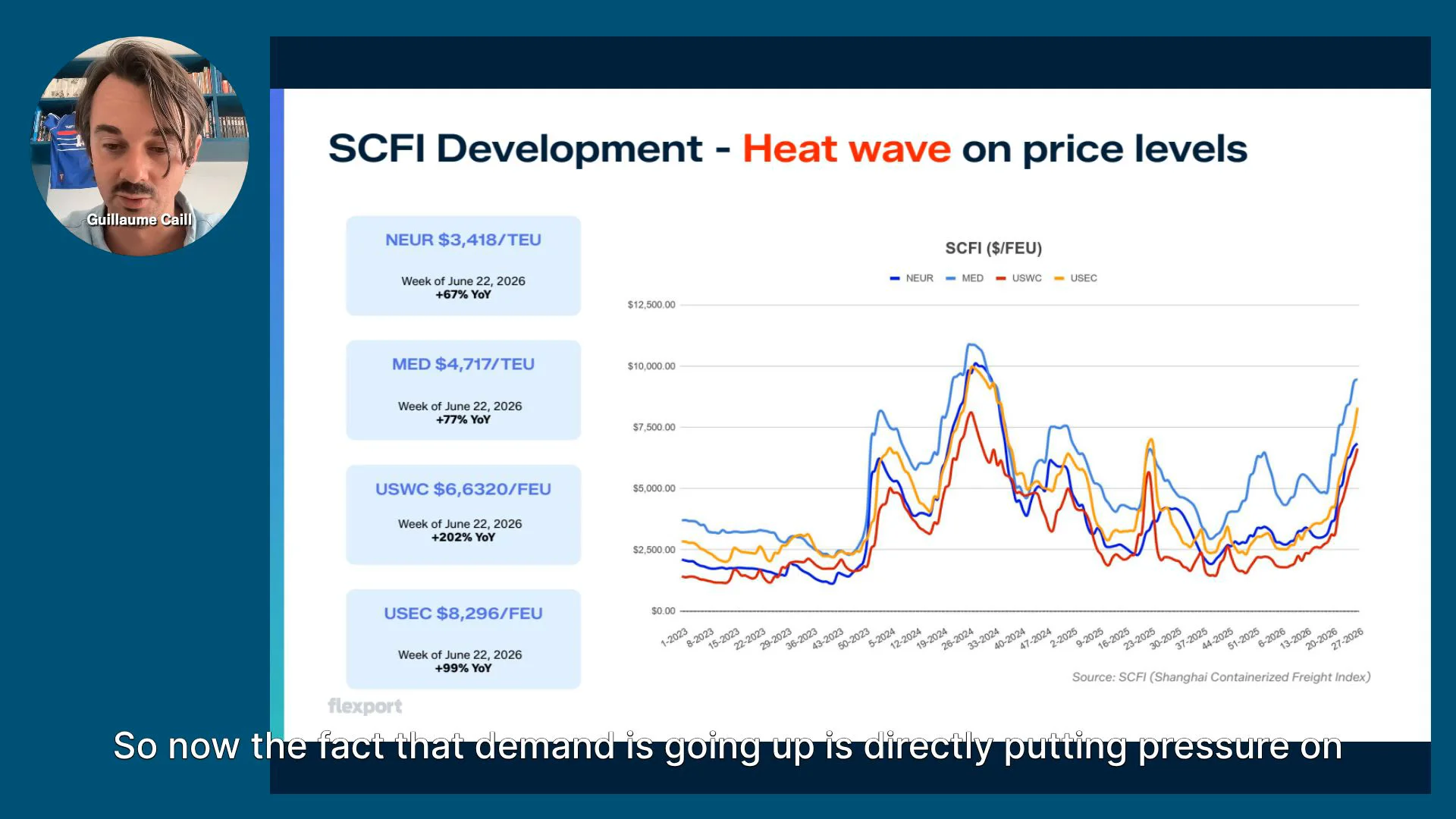
Speaker 1: So we had a pretty heated summer on on the price developments. What you can see here on this very colorful graph is the Shanghai containerized index to North Europe, the Mediterranean, the US West Coast, and US East Coast. On the left side, it's a snapshot of that index that was taken the twenty second of June.
Speaker 1: You can see there very large year over year rate increases. So we had a very strong summer peak, both in particular in the demand side. So we had a lot of Christmas restocking that had already begun. Right?
Speaker 1: So since the Red Sea since the the Red Sea is is is blocked mostly to to North Europe, we we do have longer transit time, longer lead time. So Christmas restocking happened earlier, right, because it just takes longer to get to North Europe. We also observed from some big retailer an increase of their of their order because we did see some consumer moving their spendings from travel to goods because some of the flight tickets increased because the fuel increase that happened after almost closure, and also because a lot of destination around the Middle East region we are not accessible. Right?
Speaker 1: So so that's less traveler, more spending on retail. So we also see some impact there, and and we see some large retailers, basically, restocking more than usual over the periods.
Speaker 1: Last year, we also saw some some orders that were basically kept on hold immediately after the almost situation, where, like, now shippers have decided to send them over, whether it's to the Europe to Europe or to the US. So all in all, they were, a peak season of demand from May, June, and we still see that in July. That's bigger than expected. That's bigger than last year as well.
Speaker 1: On price, respond, and we'll come back on next slide, but demand was up two digit year over year over the last quarter. It's pretty substantially outpaced the capacity increase.
Speaker 1: On TP, we did see North American imports looking down year over year since Liberation Day in May last year. But in for May this year, we had, like, a stronger year over year developments. Of course, that starts from a lower baseline from May last year, but also because there is a lot of restocking happening after a few dark months, let's say, on on the on the container trade flow to the US. And on top of that, for CP, in particular, this is a trade where carrier cooked basically with the low demand, and they didn't have any capacity over the last year on that trade.
Speaker 1: So now the fact that demand is going up is directly putting pressure on the capacity available.
Speaker 1: What's the outlook on that? Well, June and July has been and still is a pretty constant struggle to get access to space. Right? We've seen the spot rates going up.
Speaker 1: If you have fixed contract, you do see allocation being very tightly followed by the carriers. You can also see some fixed surcharge applying. We expect, though, that we are now on top of the mountain, so we would see some stabilization and and some breathing room coming now till probably mid August, and then we anticipate that the usual seasonality triggers rate decline. So from mid August, usually till golden week, early October, we we serve a declining wave in term of price developments, and we do hope that by September, we will also not have any space issue anymore.
Speaker 1: Talking about space, I want to address a question that we receive a lot from different shipper is there are big new vessel announcement and being put on the water every day at most, but why would we see the overcapacity kicking in?
Speaker 1: Well, because the shipping markets follows pretty well demand versus supply dynamic, and you see that in slack period. Right? Whenever we are in a slack period, the rates drop fast. We will see that again probably by September and October.
Speaker 1: But whenever carriers are having load factors that are reaching the eighty, ninety percent plus, then they can basically use the pricing tool to improve their profitability and also to prioritize higher paying cargo. Right? And today, in peak season, we see those load factors being reached pretty easily for them. There are a few reasons that explain that. So, yes, there is new vessel being put on the water, but the added capacity year over year in June so from January to June is around six percent. We will end up the year around seven, eight percent.
Speaker 1: So it's not even coping with a free increase of the demands in some busy trade like.
Speaker 1: We have congestion issue that are lasting long in North Europe, building up in Asia during peak. Whenever a vessel is waiting for bus slots in front of a terminal, it's a vessel that's not moving cargo. Today, we consider that five to six percent of the global fleets is waiting for bus slots in front of a terminal. So that's as much capacity that's being absorbed artificially.
Speaker 1: We have longer transit time. Right? So as long as we have a lot of vessel going via cap of the whole piece of going via SWIS, then you need more vessel basically to cope with the content of the the content of load needs to move.
Speaker 1: We still have a reliability that's not bad to pre COVID. So whenever a facility is late, that's just a longer transit time. That is some more capacity needed to serve to move cargo around the globe.
Speaker 1: We had weather conditions. This happen every year, but it's always something to remind whenever there's a storm somewhere. And at the moment, in Asia, we had the the the the typhoon Davy, which affects terminal operation. So some of the biggest terminal in Shanghai, Yangtze, and Ningbo over the last week had had to close for a day or two. So that definitely generates delays at origin, which then increase volume backlog for permission from shipping line. So all those reasons are putting enough pressure on the capacity available outside. So if you add up the vessel, I mean, put on the water on one end, but you subtract all of these factors on on the other end, you see that there's not such an overcapacity situation today in in the ocean market.
Speaker 1: Yes. The next few years, there will be more and more added supply around. We will see the capacity station improving gradually.
Speaker 1: But but at the moment, it's it's pretty reasonable for the if you're from a carrier point of view, you face pretty large, pretty high load factors year round, and you see that in two very clear indicators. One is, globally, there is less than one percent of the global fleet container fleet that is being unused. So pre COVID, it was to be an average three, four percent. So carriers are basically using all the free data available to move cargo around.
Speaker 1: And the sharper market to the price of renting container they sell to move goods has stayed consistently high since rates. It has not gone down. That means that carriers in shipping line are still paying high prices to rent more capacities because they face pretty high load factors. So for now, we would not expect this to change to the end of the year. Season eighty will make the price going down, of course, in September and October before it goes up again pre Chinese New Year. And only the years and and and hopefully, also some the calendar year, which will help bringing a bit of calendar year.
Speaker 1: Alright. That's a lot. I'm concluding now on the ocean side with some general recommendation.
Speaker 1: Whenever it's a peak season, we formulate the same recall. Secure space early, meaning four to five weeks before your target ETL.
Speaker 1: If you have any urgent cargo that need to be in your open shelves before Christmas and you're you need to get them out as fast as possible, consider premium products. You have more flexibility. You can find earlier ETDs. Always be mindful booking smaller lots to decrease the risk of rolling if you book a shipment with thirty, forty two SKUs carriers targeting those first when it comes to roll.
Speaker 1: As you will see the markets stabilizing, do not jump on the first fixed rate that comes to you. There will be better opportunities coming up in September for October starts normally, and keep diversifying. Right? We keep seeing that, but don't go only with one type of contract.
Speaker 1: The fixed contract is never totally fixed. Right? We've seen that with many peak season now being pushed. We've seen that with fuel surcharge.
Speaker 1: So it's important to always agree with your carrier and your supplier on a plan b, whether it's a floating contract, an index deal, a premium solution, try to agree beforehand on what are the backup solution you want to use when space is restricted on on your fixed rates. Volatility will remain, so it's good to be ready for the next week.
Speaker 1: Good. That was it for the Ocean update. Courtney, I'm gonna give the floor to you now.
Speaker 3: Thank you so much. Hi, everybody. Good afternoon. My name is Courtney Ozgenai. As mentioned, my role here at Flexport is the global customs director. So I come to you today with some exciting news on three trade agreements.
Speaker 3: So this EU US trade agreement is actually now live. This one kinda snuck in on us. I'm sure everybody remembers all of the chaos of the past maybe fifteen, eighteen months. It really was the tariff environment in the United States.
Speaker 3: As Guy was mentioning, you know, in April, we had a liberation day, and then that's really when everything in the world of those reciprocal IEPAs ramped up. Those have obviously been terminated in the US now. But during that time, there were a lot of negotiations between different countries to try to get a more favorable rate and not be subject to those really aggressive IEPA rates. And so this actual EU EU US trade agreement was actually sort of from that framework.
Speaker 3: And so this was negotiated back then and actually just ended up going live at the beginning of July.
Speaker 3: It is in effect now, and it does terminate at the end of twenty twenty nine. So this will be in effect for the next few years. And there's three different types of annexes. So there's annex one, which is a full duty elimination. It is immediate. It's zero percent on US origin goods, It covers chemicals, pharma, metals, some machinery.
Speaker 3: And then you've got annex two, which is partial relief. So it removes the percentage of the duty rate, and it remains just an entry price, and it covers some fresh fruits and vegetables.
Speaker 3: And then the last is a tariff rate quota. So there's certain tariffs where it's a really, it's a threshold, so you're allowed to bring in so much of a certain commodity. Once it hits that quota, then you're gonna be subject to the standard duty rates that are in effect. So those have really just sort of a window of opportunity where you can bring in so much. Once that quote is full, then you're gonna revert back to that standard rate, and that is on, some meat and dairy seafood product.
Speaker 3: So just so you guys know that this one is actually live. So if you have products that are subject to any of these annexes, definitely take a look at that and try to see if you can take advantage of these reduced or duty free rates that are in effect. And then how do they qualify? So very common with a, free trade agreement that's out there, the goods need to be wholly obtained in the US or they need to have had a substantial transformation. So what that means is that if you had a product, there was an assembly or a manufacturing that happened, it changed what that actual HTS or what the actual product was to a new commodity that would be classified under that new ruling. That would then be a new country of origin that would suffice for rules of origin.
Speaker 3: So you wanna make sure you've got documentation for that. That's always key when you're trying to get any sort of duty reduction or duty free treatment is make sure you've got, made in the USA stamped on your goods. There's a country of origin that can be backed up, either notarized or stamped off by your factory manufacturer. Just something to really prove that there is a basis for that claim should you ever go through an audit or be subject to any sort of investigation that guarantees those duty free rates.
Speaker 3: And then oh, one other thing to call out is that you wanna make sure that these goods are all also sailing in transit so they cannot be, you know, going to other countries, going there, and then going into the EU. They really have to move directly from the US into the EU or remain within customs control during the transit so that they are not entered into commerce into another, you know, third entity and then coming into the EU that would void their claim for the rule of origin.
Speaker 3: Alright. So the next one is the e UK India, agreement that's going live. It's the comprehensive economic and trade agreement, and this is actually going live tomorrow. And this is the largest bilateral trade agreement since the UK left the EU. So that's very exciting, obviously, and that it looks like it's gonna be in place for up to ten years. So there's several categories as listed here from clothing, jewelry, seafood, vehicles, and then there's different types of impact on those tariffs. So it's expecting to have a huge economic impact, and it's obviously very exciting that we've got another free trade agreement going in place between the UK and India.
Speaker 3: And then how do goods qualify? Similar to the one that we were just reviewing between the US and the EU, you wanna ensure that those goods were wholly obtained in their country of origin or went through a specific sufficient transformation, you know, qualifying into a tariff heading or, you know, there's qualifying value content. And same as in the other free trade agreement, ensuring that there is a certificate of origin, that there's proof of that origin or the validity of that claim, making sure that something is stamped off by an approved entity. I mean, often, those certificates of origin can cover, you know, like, a bundling of shipments.
Speaker 3: You don't necessarily have to have one per transaction. If you've got a factory making that same product, you can have a statement that would cover, you know, a blanket statement of those goods, and there's a provision that allows them to cover up for twelve months under this agreement. So same you know, similar to the EU and the US, just ensuring that you've got your documentation in place, that you're working with a broker who understands all of these rules and regulations, and that you would have any paperwork to support those claims should you go under an audit or be asked for additional details.
Speaker 3: So just a quick recap here for everybody on the call that there are these two new deals that are going live. The EU US one went live beginning of July, and the UK India one is gonna go into effect tomorrow.
Speaker 3: Just ensure that you are working with a broker who can help support all of your documentation, understands the complexity of this, can help you navigate any of these requirements that are out there, make sure you've got your documentation, and I would always recommend working with your suppliers so that you map out that supply chain. Make sure you're working with suppliers that understand this as well so that they can help you with the required, documentation of origin so that way you have sufficient backup for those claims and hopefully can benefit from additional, duty free or duty reduced treatment.
Speaker 3: So with that, I'm gonna invite Guillaume to come back up on stage.
Speaker 1: And there I am.
Speaker 1: Thanks, Courtney.
Speaker 1: Good. That might be similar effects, but there's no question left today, so we will jump over the q and a.
Speaker 1: Of course, if there's any follow-up questions you have, feel free to reach out to your Flexbox representative, and and we'll we'll be happy to to to give you an answer offline.
Speaker 1: In the meantime, or to conclude, to say that we to talk a bit about our next prediction guide. So we did one in January, and it feels a very long time ago. So the forecast we run back at that time regarding rates, capacity, demand developments, clearly need a refresh after all that happened since March. So to help us with it, we gather some intel from some of the best industry experts. We had Peter Sand from Zeneta, Chris Rogers from S and P Global, and and Martin Former from Avon. And we asked them simple question, what are you predicting for the next few months, and what should Cheaper do about it?
Speaker 1: So the guide is almost ready. We have a few prediction for h two twenty twenty six that will touch ocean, air, move, and just macro economic environments with some specific action that you can take and follow. So if you want to receive that guides, just respond to the poll, and we will send it straight to you in your inbox as soon as it's available.
Speaker 1: Alright. That's it now for today. Thanks, everyone, for attending. We will receive you'll receive an email with the recording tomorrow morning.
Speaker 1: Next FMU will be after the summer, in September. So in the meantime, have a great summer. For those of you who have holidays, enjoy, and we'll speak later.
Related webinars
 Market UpdatesSeptember 10, 2026Register
North America Freight Market Update Live
Join Flexport experts live on September 10 for the North America Freight Market Update: trade lane news, ocean and air capacity, and where rates are heading.
 Market UpdatesSeptember 8, 2026Watch now
European Freight Market Update Live
Flexport's 8 September 2026 European market update: trade lane news, ocean and air capacity, rate movements, and the regulatory changes worth planning around.
 Market UpdatesAugust 13, 2026Watch now
North America Freight Market Update Live
Watch the on-demand August 2026 North America Freight Market Update, where Flexport experts cover trade lane news, ocean and air capacity, and rates.
- Market UpdatesJuly 16, 2026Watch now
North America Freight Market Update Live
Flexport's July 2026 North America market update: trade lane news, ocean and air capacity, and where rates were heading.