Supply Chain Therapy with Flexport and Simple Modern
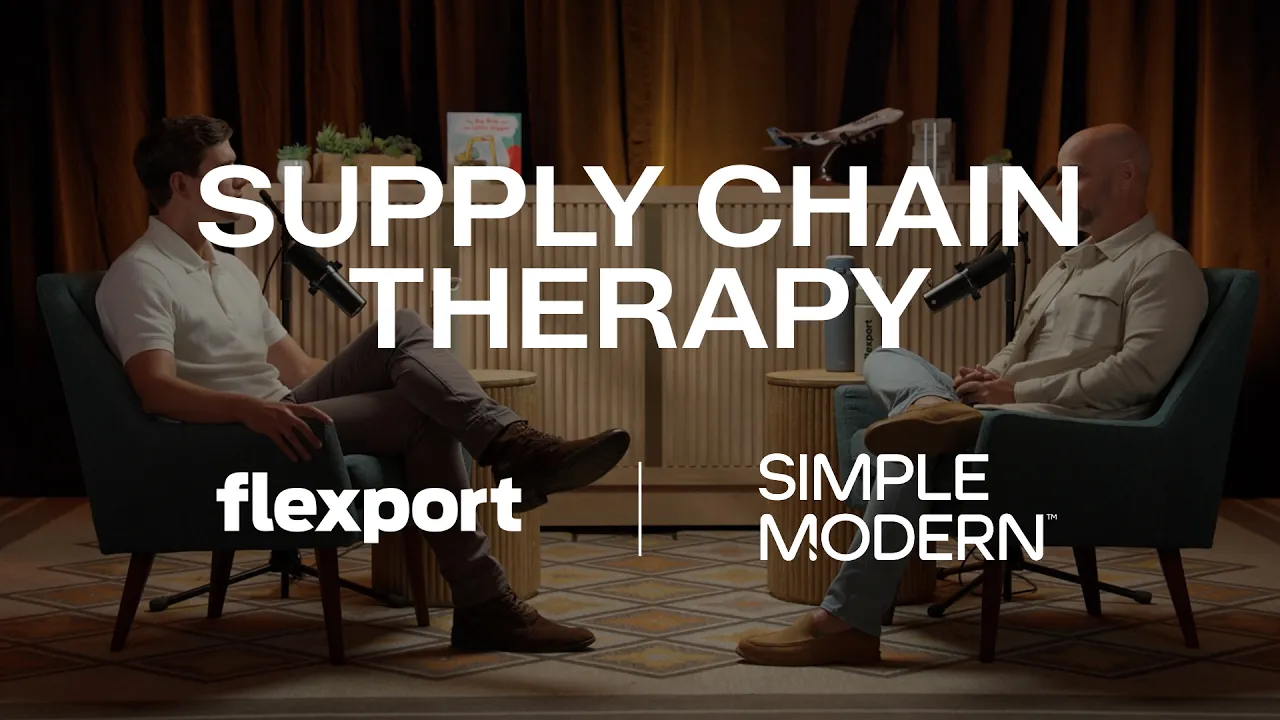
Supply Chain Therapy with Flexport and Simple Modern
The below transcript has been generated by an AI system and may contain inaccuracies, errors, or omissions. While efforts have been made to ensure the accuracy of the content, the AI-generated transcript should not be considered fully reliable or definitive record.
Lee Graves:
Early on we didn't know how to make anything or ship anything. And now we have a whole team, you know, kind of dedicated to this and the scale has grown a lot. But early on it was developing factory relationships in China. So a lot of travel, a lot of learning about that culture and getting them to do kind of our crazy ideas especially… when you're a nobody that's a different type of selling where you're trying to just convince them to believe in our future.
Ted Boeglin
Hi, everybody. I am Ted Boeglin, and it's my pleasure to be joined by Lee Graves. Lee is the chief manufacturing and logistics officer at Simple Modern. I've also found Lee through conversation to be one of the most insightful and values driven operations leaders that I've had the pleasure to meet Lee. I know that your title is only a small fraction of what you've done over time at Simple Modern. Maybe the place to start is by telling us the Simple Modern story, sure, and the various different roles that you've played in its success over the years.
Lee Graves
Sure. Well, the Simple Modern story started with three founders that really wanted to, they really just wanted to have a business where they could act out of their values in general. And so it was less, they had a skill set around online particularly Amazon selling. But really it was just three guys that wanted to work together and make an impact in the world and to build a great culture. And so culture has been kind of at the heart of what we've started at Simple Modern, what we've wanted to exhibit both internally and externally. And so we have a lot of phrases where we talk about being relational or transactional or we talk about, you know, wanting to be generous and we think of generosity. Both typical thought process would be generosity through just monetary means where we write a check for someone, but you can be generous with your time. You can be generous with… your affirmation of someone. There's just a lot of ways you can be generous. And we've tried to just kind of build an environment around that. And we really think of the business itself as just the way to fund this thing that we're trying to do. And so the culture is first. And really the water bottles end up being second to that.
Ted Boeglin
And you were there in the.
Lee Graves
early days, very early. Yeah, I'm not a technical founder. I was one of the earliest hires. The CEO and I have a very long friendship. We always wanted to work together. So it's been for me to be able to work with your close friend has been a huge blessing and I was brought in to… the easiest way to put it is to make and ship everything. And that role has persisted although it's you know, early on we didn't know how to make anything or ship anything. And now we have a whole team, you know, kind of dedicated to this and the scale has grown a lot. But early on it was developing factory relationships in China. So a lot of travel, a lot of learning about that culture and getting them to do kind of our crazy ideas especially… when you're a nobody that's a different type of selling where you're trying to just convince them to believe in our future. And then obviously the shipping side getting it from there to the us and then the warehousing fulfillment side. All those pieces are kind of what we had to figure out very early on.
Ted Boeglin
It's so interesting when we sometimes talk to Ryan, our founder. One of the things he coaches us on is he said that it's a very powerful thing to have a learning objective to walk into a situation and truly want to learn about a new subject. It's very hard to fail if you have a learning objective. I'm sure in those early years, you had a lot of learning objectives trying to figure out how to make product and move that product. What were some of the key things that you felt like helped you learn quickly and effectively because obviously it's a success story. So you ended up making a great product and being very successful moving it?
Lee Graves
You have to like problem solving and you have to want to learn. So a curious individual, you know, it's a driver of success in a startup where you know nothing and then you've got to distill it down into the most important thing because there's a lot of curiosity that can not really drive the business forward. And so trying to find the right thing, the right question to ask at the right time. And I think we had to develop some kind of first order first level kind of principle thinking… some kind of natural beliefs can nest under that. And understanding the individual that you're working with was a big part. So being curious about what makes the Chinese factory successful? And being curious about what makes the individual who you're talking to, what are they trying to achieve? And then trying to align our incentives with theirs, being curious about their culture and the way that they think not so that they can think like us so that we can meet them in the middle and have great communication. All those were big drivers early on for us.
Ted Boeglin
You all have been very outspoken about how much value you place in these partnerships. You want them to be long term partnerships, help us understand where this mindset came from. And some of the advantages that you've accrued over time to these compounding relationships that you've been able to build with key partners. So.
Lee Graves
That's another first order principle. It starts with our team internally. There's a realization that you spend so much time with the people you work with. So if you get to choose which we were blessed enough to be able to choose that in a startup, it's like, well, you want to be around people that you want to be around. And then you want to cultivate that so that you continue to want to be around them. And with partners, it's the same thing. And we kind of have this intent that we're made to work. We're going to be here doing what we're doing for a very long time, not looking to retire, not looking to sell. So how do we make it most enjoyable as possible for us? And that is building relationships and some are wired this way, I think where they just want to get the best deal that's just not who we are. And so we know that about ourselves and so trying to build long term partner relationships fits into that as well. And it's effort. But I do think that it makes a stronger long term. I think we could do better in the short term, you know, beating people up on price or being very transactional… but I don't think that that'll make you strong in the long term and it won't make it as enjoyable. It's a lot more stressful. And when you have a problem and they view it as their problem as well. And you find partners that think like that, then you can really, you win on all sorts of levels and you enjoy your experience a lot more.
Ted Boeglin
It reminds me of sort of the value of play the long game or be a long term optimizer or long term greedy in a relationship rather than short term. And you've certainly had your partnerships stress tested since the founding until now, what were some of those key moments where you really had to lean on a partner or someone to help carry you through a time of risk or uncertainty?
Lee Graves
Sure. So we've had a lot that have happened. I mean, a lot of things have happened since we've been around 10 years. This is our tenth year. And so we've gotten to experience some big changes. Covid being one obviously that impacted the whole world, but it was very difficult and then the supply crunch that followed, you know, having to deal with port problems and shipping problems and things shutting down. And then we've had quality problems that we had a big quality problem at one point that was formative for us and we were able to use that as a catalyst for other things in our business. But the relationships in the middle of that, when things were going very poorly, we knew that like covid, for instance, our good relationship with our factory in China because… the relationship was built, we were always able to punch above our weight for the size that we were. So there were bigger customers that they had. And we believe, and I think it's true that we weren't the biggest necessarily early on but we were the most liked. And so that means that you get, if there's a tie, then we kind of win in the tie situation. And so in covid, for instance, you get priority when the factory is shutting down because they have a power curtailment, and so they're like, well, we're going to get your stuff out. And that's just because they like you. And when you have a relationship with somebody that just likes you and you don't even have to ask, they take care of you and it's really a true partnership kind of a family. And so we've kind of viewed that type of relationship as a way to drive our success. And we look for that. We look for that in selling partners as well. People that want to, we want to give them products that really help them win. So on the selling side, we talk to the buyers about their goals and we talk to the we're looking for products that kind of fill holes in their, in what they offer… part of how we were able to become omnichannel, speaking of solving people's problems was we had developed a capability with selling online and selling online was kind of this thing that people didn't understand, you know, as recently as the last, you know, 10 years and they're looking for people who know about it. And so we were able to use our success on Amazon to get us into positions with Sam's club, or with walmart or target because we had helped them with their online selling goals. And, that was kind of how we were able to get in the door with them.
Ted Boeglin
One of the topics that I've heard Mike talk about before when you all were first conceptualizing Simple Modern was the idea of red ocean, blue, ocean product categories. And the idea there is that, you know, red ocean product categories, very competitive. Lots of brands are in the space, blue ocean is the opposite, you know, more open. And the water bottle category is red ocean. And you all dove in with two feet and you had to have some core thesis about what would differentiate you that was frankly outside of just being really good at sales online. So, what were some of those? Because I mean it's a beautiful product. You know, we've got some Simple Modern water bottles up here with us. So what were some of those core ideas about what would make a great product?
Lee Graves
Well, to address the red ocean, blue ocean thing is a great thing to think about because you can be successful in both places. But there are trade offs. And one of the big trade offs with blue ocean is you do not, if there's no competitors, it's either because it's so novel and unique and special that no one's ever thought about it or nobody wants it. And so blue ocean's risky in a different way. But most people in general I think are like, man, I gotta go somewhere where there's no competitors. If you think about it differently, it's counterintuitive. But a red ocean strategy says, well, I know that a lot of people want this and I believe that there is enough room for one more and we've just got to find the right angle. So for us and I think for any business you're really looking for what's that hook, what's that reason for someone to talk about a thing. And you're trying to find that. And if you find it, you can really push on that and you'll find if that really resonates with customers pretty quickly. So in the water bottle space, there were a few specific dynamics that existed at the time. And one of them was ornamentations or optionality. When simple honor first started, yeti, was becoming a big company. Already, they were successful in this space, but they primarily just offered a stainless steel colored bottle. And… other competitors of theirs were the same way. And I think because if you combine that with the idea of the way that they were typically selling was in a store. So in the store there's only so many shelves. There's so many spots where you can put a bottle so you can't really have that many colors. You can't have that much optionality because you have a physical limitation. And so we were online centric. We were online native. And in that world, you have an unlimited shelf space. And if what we found at least a thesis that we had was there may not be millions of people who want a yellow water bottle, but there might be some and no one really wants to be, nobody wants to make that for the small amount. But we could have 100 percent of the market of people who want yellow water bottles. And so we very quickly moved into ornamentation optionality. So lots of colors and buy lots of colors. Our first po was for 10 colors. And I remember that the factory was just kind of floored by that. I was like 10 colors is a lot of colors. And now it's kind of a silly thing because there's just so many options, but back then the idea of it being a fashion accessory was just emerging. But if you talk to people and they're carrying this thing around with them all the time, they're going to be thinking, oh, this doesn't match my clothes. And we tapped into that early. I think that was a key identification for us. Well.
Ted Boeglin
You were also early to partnerships too?
Lee Graves
Absolutely, you know?
Ted Boeglin
Some key partnerships that allowed you to create very unique bottles or things that help speak to identity and fashion. What were some of those key early partnerships? So that was the other.
Lee Graves
Key unlock was… most of the early Simple Modern team went to the university of Oklahoma at the time. No one had a stainless steel water bottle with an ou logo on it. And the team had the idea to like man, this would be really cool if we could take this stainless steel water bottle, make it be the color of the school and, put the logo. And… the, as the way that it works is it's a very tightly controlled IP. So there's a small number of groups that control all of, the collegiate university licenses and you really can't get in especially if you're a nobody but you can get a regional license. And we were able to through some contacts at ou get the ou license. And basically what that means is you can sell it locally. You can sell it around town, had some samples made. And there was this key moment of product market fit that Mike likes to tell where he was sitting at a restaurant and had his ou bottle on the table. And someone came from across the room to say, I've got to have one of those. I wonder what that is. And I think at that moment, it was like, okay, we may have something here. And when you're a nobody, when you're small, you've got to find a way to get people to notice. And so took that product and pitched it to Sam's club and said, hey, we want to, we want to do this and we want to put collegiate logos on water bottles and sell them to you guys. And, you know, in kind of one of those serendipitous moments, they, that was exactly what they were looking for. And they're like my, gosh yes, we want that, and we want to partner with you guys. And we're like that's fantastic. And, and the next statement was, well, there's one small problem is, we don't have the licenses. And so, Sam's club actually went to bat for us to go help us get the license. They gave us this po, even when we didn't have the licenses. And that po was big enough to where we were able, to go to each of these licensors and say, hey, we've got, this sale like you're we can just hand you money for this thing if you'll give us the licenses. And that really jump started us really propelled us from, to really be a company where we could actually work full time at it.
Ted Boeglin
It feels like you've had often innovation on the product side either through more colors, more ornamentation, I know an engraving business sort of advancements there, but that has to put stress upstream… on manufacturing on sort of how you manage inventory. Yeah, that's the sort of the classic tension that exists. I assume that a lot of that pressure was handed down to you as you were trying to, you know, increase skew count at a relatively modest company. So walk me through how you navigated the right bets to make, and then how you made good, on those product innovations.
Lee Graves
Well, it started with, getting the factory in particular to believe in the strategy because we, the other side that you didn't mention is we didn't have any money. And so when you with an inventory business, it's really about cash flow management. And if you have high SKU counts and you have to and, or if you desire to have high SKU counts, but you've got high moqs minimum work quantities, you can just sideline a lot of cash. And, and so we went to work first convincing them like this is how you win, believe us we will win if you do this thing and do it with us, you will win. And then, we also at the same time push down on moqs because it was like, trust us, just, let us try more things. Let's do more things. This is how you win online and… we just had a very good partner that really understood what we were trying to accomplish and they backed us in that. And… we definitely grew our SKU count very rapidly. I mean that first sams order was very quickly on the heels of me talking about the 10 color order. The first sams order was 140 colors, 142 colors or something like that. And, and it was a two pack and it was, each color had to match the primary and secondary color of these universities and we couldn't mess it up. So, so color accuracy was very difficult and we just spent an inordinate amount of time trying to make sure that it was, really high quality and had, the team there not believed in us. I think that it could have been a really uphill battle. So I put a lot of, I just appreciate them a lot for what they did to help us and believe in us. And then of course, we reciprocated by growing quickly, and that very thing is like, you push people really far. And then if you have success, it just kind of creates this legend and then they'll do anything for you and every idea that we have is a great idea and that's not true. But, but that's kind of, the reputation you develop. And so it got easier. But early on there was just a lot of selling on the concept and.
Ted Boeglin
One of the kind of key themes that I've pulled out of our conversations in the past is that you've been very successful in getting people to bet on Simple Modern yeah and believe in the mission and the vision. And you've talked about how important it is that your team are missionaries not mercenaries in pursuit, of your values. Can you talk a little bit about as a leader in the operations space? What traits are you looking for? So that you hire people who are long term committed to you going to grow with the company as it grows?
Lee Graves
Well, you, I mean, the attitude matters a lot and I think you have… to enjoy solving problems. And, and so, if you see a problem as like the kind of a life ruining day ruining thing, you tend to not be enjoyable to be around. If when you see a problem is really an opportunity to like solve a puzzle, it's a different approach. So, you lose all, the negative emotions that come along with that. It's really hard to like find that out in a job interview process. And so, because everybody's not wired that way. And, I commend I don't mind that. But, but definitely you have to be ready, to live in a world of problems. And so we've been, we've had a very tight hiring process just in general, there's a lot of word of mouth, a lot of people we know so early on it was like who do we know, that is really reliable or, that has these traits? And then of course, kind of integrity, and this relational kind of bending, is, really important because you there's when you're in a stressful environment, having a great relationship can diffuse a lot of things and people work better in that kind of environment. And so if you got a bunch of people, that are at each other's throats, then you're going to have a lot of trouble solving these hard problems. And so we're looking for kind of a level of high eq types, of individuals. And again, you kind of get that because, you know, you, it's someone you know, and, or someone you know, and you trust, and then someone they know. And this is kind of how we've kind of been able to build, this culture internally. So, very hard to get in at Simple Modern. And then we retain people for a very long time because, they enjoy the environment.
Ted Boeglin
Well, it's absolutely true. And I think one of the, one of my favorite stories about the culture that you've managed to build is, when you did, I think you had a quality problem. At one point. I think it was a lot of water bottles that had to.
Lee Graves
Get it's pretty interesting you.
Ted Boeglin
Want to tell quickly the story about because I think it's such a good anecdote about the culture that you've built within the team that they rose to this challenge. Well.
Lee Graves
It's so the, there was a moment where we had a, it has so many angles but we had a water bottle is very similar to this one. In fact, it was our previous version of, the summit water bottle and it has a relief valve in it. And so when you drink out of a water bottle, you're displacing the air inside. And if you don't have a valve, to relieve that air, it'll just resist you as you drink down the water. And so, the valve has to work. And so, the story starts in the factory who had best intentions because they had taken such ownership of, they felt like they were so much of a part of our team. They had noticed imperceptibly to us, they had noticed that there's a slight tendency to leak, you know, like man, we need to, we need to fix this. Now, we hadn't seen it in our reviews. It had not been a complaint issue but they were trying to be really, you know, on it to make sure that we had really high quality. And so they made an adjustment to the relief valve itself. And the adjustment made it to where the relief valve wouldn't leak, but it would not relieve at all. So, so it's it might as well have been plugged. And the only complaint or negative that we worked through with them was, that, you know, their ownership of the product and desire to fix it. They didn't communicate that with us. And so they ended up making a lot of bottles. It was ended up being a 1,000,000 water bottles that were made prior to us realizing there was a problem and, some had been shipped. Some had made it here. Some, a few had made it out to customers but we got it early enough. I think that we had caught some. My wife was one of the first that noticed it that it was like, this is not a good experience. And I was like that happens, you know, and then somebody else said something and we're like, okay, we might have a problem and then, you know, we had, a full freak out moment. And and then, you know, we had to assess the problem. So there were a 1,000,000 is it was kind of the number. And so we worked for the factory to come up with a solution. And really the only solution was, to actually replace the valve itself. Well, that's not in a factory setting that's not a big deal but these are already packaged and there. So you have this whole process where you have to unpackage everything, take it apart, change the valve, put it all back together, repackage. It and the, you know, the, and have good quality of product that the customer will still want to buy and a 1,000,000 bottles. The best way to think about that is let's see how many containers it's about 50 containers, 40 foot containers, and so a lot of water bottles, which is a lot, and if you've but if you've ever seen them kind of spread out, it filled up, you know, 100,000 square foot warehouse when you kind of had them all spread out. But then when you have to physically handle each one, it's a lot, and we could process, we did a bunch of tests and we're like, okay, let's set up a table, and let's deconstruct and fix this. And how do we, you know, how many can we get in a day? And we quickly realized that to get through this problem, it was gonna take years or it was gonna take a lot of people. And I'll remember, I always remember, the night, that I kind of had this eureka moment. It was super stressful for me in particular because it was like, I have to figure this out. We did not want to have all these bottles get out to the customers, ruin our reputation. We care about our customers. And so we have to fix this thing. Can't send her back to China and have them fix there's? Just lots of challenges with that. And so we had to really work with them. It could have ruined our relationship with them. So we're wanting to kind of like balance all of these things. And so, the solution was we just had to do the hard thing of fixing these bottles. And I was having dinner with some friends and they had a son who was in high school and it was summertime luckily. And I was like, hey, what's your kid doing? And they're like he's not doing anything. And I'm like, what if I hired him to do this? And they're like, yeah, yeah, he'd do it. And I'm like, what if he called all of his friends and I hired them and then they're like, yeah, maybe. And, and so then we started kind of going through the rolodex of anybody we knew that had like a college or older high school kid and get all their friends to come help us. And we ended up hiring and we, at this point, I was like I'll pay him anything. And, for a kid, I think we paid him, I think 20 dollars an hour or something. And, and which was, which is a lot for a kid for a summer job, and I think we might have had a bonus at the backside if they stayed the whole summer, and we just set it up to where like we're gonna get this done in six weeks. And we ended up hiring something like 50 kids and… it was really kind of one of the most stressful things but also a really rewarding thing to kind of spin this thing up. We actually realized that the, one of the hardest scariest things we can just, we can actually do it. You just have to be creative and thoughtful, and really, the relationship piece that we just had around the community and the people that we knew, and you know, spread like wildfire. I think part of it was that we were paying a lot and part of it that the… people knew who we were, that it was a good place they trusted their kids to come into a warehouse environment that we're overseeing. And, and so, it was a great experience you know, on the back end for us to kind of work through a hard thing, but to see some of our principals in action.
Ted Boeglin
I think it's just the perfect story to encapsulate so much the communities they're helping you because you've invested in the community and you've built a culture where you're willing to rework a 1,000,000 water bottles to deliver for the customer. So, Lee, I just want to say, thank you so much for joining me. This has been tremendously fun to hear the stories and congratulations on all of Simple Modern success and all that is yet to come. Thank you. Thank.
Lee Graves
You. I enjoyed it.
Related videos
 Supply Chain Therapy24 Minute WatchWatch now
Supply Chain Therapy with Flexport and RTIC
How does a company pivot from moving boxes to dominating the market for premium, durable coolers? In this episode of Supply Chain Therapy, Flexport’s President, Sanne Manders, sits down with RTIC’s Chief Operating Officer, Chris Chelko, to discuss the brand’s incredible…
 Supply Chain Therapy32 Minute WatchWatch now
Supply Chain Therapy with Flexport and goodr
How does a disruptive, mission-driven brand like goodr keep its fun, accessible brand promise while scaling its supply chain globally? In this episode of Supply Chain Therapy, Flexport’s SVP, North America, Ted Boeglin, and Goodr's VP of Operations, Greg Bicksler, dive into the…
 Supply Chain Therapy27 Minute WatchWatch now
Supply Chain Therapy with Flexport and Portland Leather
How did Portland Leather Goods transform a passion for quality craftsmanship into a rapidly scaling retail powerhouse?
 Supply Chain Therapy28 Minute WatchWatch now
Supply Chain Therapy with Flexport and MANSCAPED®
How does a brand transform from a localized startup into a global lifestyle leader in just a few years? For MANSCAPED®, the path to success required more than just a viral product, it required an obsession with operational agility and a sophisticated approach to omnichannel…