Trends to Watch
[Ocean - TPEB] Effective capacity remains at an oversupply as carriers announce more blank sailings and try to reign in further rate drops (rates are currently at pre-pandemic levels). Expect possible loading limitations on some U.S. East Coast and Gulf Coast services due to the draft restrictions on the Panama Canal.
[Ocean - Indian Subcontinent] Available capacity remains high with strong equipment availability at coastal ports. Some inland container depots (ICDs) are reporting deficits and availability is dependent on the import mix into these inland destinations, with 20ft equipment remaining the most challenging.
[Ocean - TAWB] Rates continue their downward trend as capacity remains high while demand stays low. Expect this trend to continue through Q3’23. Equipment is widely available at all major European ports—with decreased congestion in both the U.S. and Europe container turnaround is quicker, leaving more equipment available.
[Air - Asia] After bottoming out in May, rates on Asia-EU routes have rebounded and the difference between spot rates and fixed contracts is reducing. Overall, demand has recovered, though freighter capacity is being retired—specifically on Transpacific as they lose money at low sell rates and high fuel costs. This will continue if the rate and fuel cost situations don’t improve.
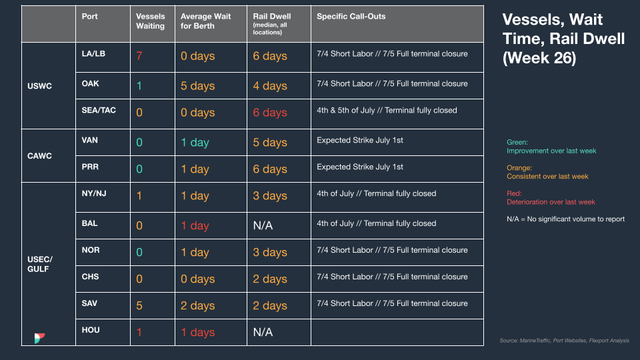
[Trucking - U.S. import/export] Starting July 1st, 2023 the regulated trip rates and hourly comp for local dray in Vancouver, BC increased by 6.2 % for all local container drayage services. Wildfires in Alberta have delayed rail moves, yard utilization has stabilized but rail is underperforming. U.S. wet and rail ports are largely fluid, with truck turn times under one hour at most ports. It remains to be seen what impact labor actions at B.C. ports will have.
North America Vessel Dwell Times
For more details, please visit Flexport’s Ocean Timeliness and Air Timeliness indicator pages.