Five executive orders came out of the White House on Tuesday evening. Two of them add products to the 50% Section 338 duty lists on Canadian goods, effective September 15. The other three prohibit certain Canadian products from entering the United States at all, effective September 29.
Those two dates have different requirements. September 15 is when duty changes affect your landed costs, and for some products, there could be a 100% total duty liability. The tariff changes taking effect on September 29 work differently; if a prohibited good doesn’t clear, it can’t come in.
September 15: more products on the 50% list, and change to tariff stacking
The two modification orders pull a long list of additional Canadian goods onto the Section 338 lists. Food and consumer goods make up part of it: cheese, animal hides and leather, motorboats, outboard motors, golf carts, furniture, mattresses, LED lamps. The remainder is industrial and paper: paper, paperboard, writing paper, electrodes, and signs.
The orders also add iron and steel columns, posts and beams, plus aluminum pipe and profile shapes. Those products already pay Section 232 duties, and the order is explicit that the new duties "shall apply in addition to duties imposed pursuant to section 232." Aluminum profiles under 7604.10.10.00 are one example. Fifty percent under Section 232, another 50% under Section 338, and the duty rate is at 100%.
A few things came off the list, such as table salt under 2501.00.00.00 is no longer subject to Section 338. Whiskies not elsewhere specified in containers holding more than four liters (2208.30.6085) and liqueurs and cordials in containers over four liters (2208.70.0060) also both came off the list. Anything four liters or under still pays the duty rate. Bulk whisky in a cask gets relief and the same whisky in a bottle does not.
One more consideration: qualifying under the United States-Mexico-Canada Agreement (USMCA) exempts Canadian goods from Section 301 duties, but it does nothing for Section 338. Furniture importers in particular should not read a USMCA certificate as protection here.
September 29: three orders that prohibit entry rather than tax
While most tariff changes have impacted costs, three of the orders bar imports outright.
Motorcycles over 800cc, classified in 8711.50.00, are prohibited. Note that the Explanatory Notes cover three-wheeled motorcycles too, as long as they lack the structural characteristics of a conventional passenger car under heading 8703.
Whey, molasses, and non-alcoholic beer from Canada are prohibited under a separate dairy-focused order.
Beer, brandy, rum, and wine from Canada are prohibited under a fourth order, with a carve-out that matters commercially. Large vats and casks are exempt, but direct to consumer forms like bottles, kegs, and cans are subject to these new duties. A Canadian producer shipping bulk wine to a U.S. bottler is in a different position than one shipping finished cases.
What to do next
Pull your entry data for Canada-origin goods and sort it by HTS code. The additions this week hit specific codes, and the removals hit specific container sizes.
For anything that is already impacted by Section 232, check whether it appears on the new Section 338 annexes. If you have goods on the September 29 prohibition lists, your remaining decisions are about truck shipments already booked and orders not yet placed. If your product will be prohibited, it may be worth increasing your imports quickly over the next few weeks. Landed dates, not booking dates, determine what gets in.
The Tariff Simulator is already updated with everything above. You can pull any Canadian HTS code, set an entry date of September 16 or later, and see the stacked rate rather than reconstructing it from five annexes.
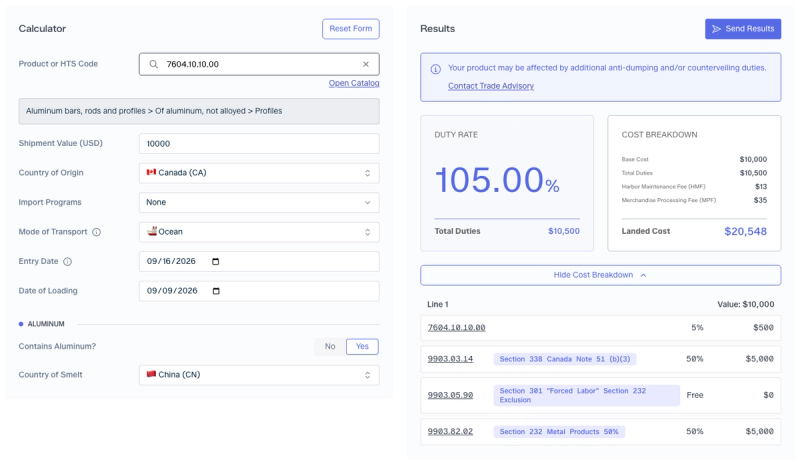
Canada became the second most-searched country in the tool last month, after China, which tells you how many importers are doing this math right now. The Simulator will also flag when a product falls under the September 29 prohibitions.
For additional details and information, we are hosting a Tariff Trends 2026 webinar on Wednesday, September 16 at 9:00 am PT / 12:00 pm ET. Register here. We’ll cover these orders alongside the expiring Section 122 tariffs and what both mean for clearance accuracy.
If you are looking for more specialized guidance, contact our team, we’re here to help.