[MUSIC PLAYING]
PHIL LEVY: He trades what and why?
I grew up in Wisconsin and I like bananas.
And to the best of my knowledge, there has never been a single banana grown in Wisconsin. Why is that, you ask? Bananas like warm tropical climates to grow in and that's not a very good description of Wisconsin. So I got bananas from Costa Rica, let's say.
Now, that begs a bigger question. Why was Costa Rica willing to send me bananas? They're nice people, of course. But if they're going to spend their days growing bananas, they'll want something in return.
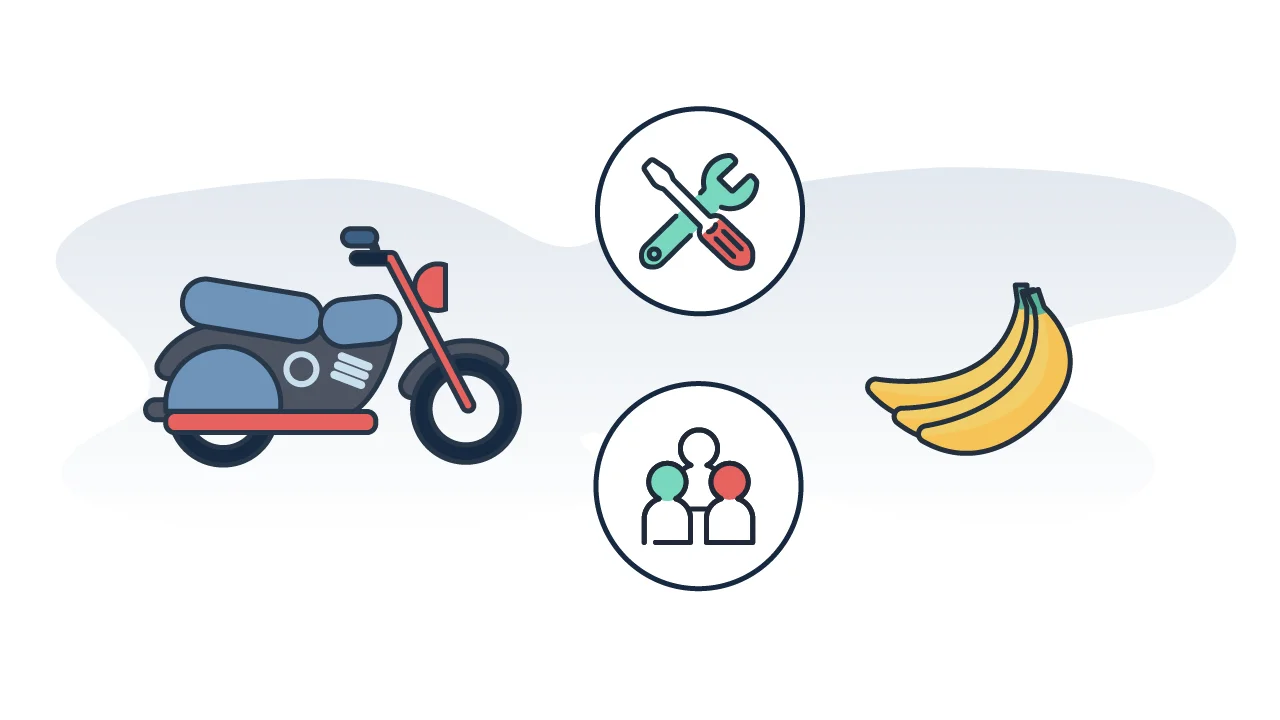
Of course, Wisconsin can trade, let's say, motorcycles. Why would those be made in Wisconsin? Well, they require both physical capital, a fancy way of saying machines, and human capital, skills.
And Wisconsin has both of those.
So I've just told a story about why Costa Rica would have a comparative advantage in making bananas and, Wisconsin, a comparative advantage in making motorcycles. It had to do with either the technology behind production or with the different places, endowments of key inputs like warm weather in the case of the bananas.
The upshot of these differences would be that if we didn't have trade, bananas would be very expensive in Wisconsin relative to motorcycles. And the reverse would be true in Costa Rica.
Trade is what lets both Costa Ricans and the Wisconsinians be better off. So the first idea that we want to focus on in terms of why we trade is comparative advantage. So different places are able to make different goods relatively cheaply, and they're both better off when they swap.
All right, let's stick with that comparative advantage idea for a moment and add a couple of twists.
First twist, there are more than two places in the world. So Costa Ricans don't have to like motorcycles. Instead, they could send their bananas to Wisconsin, motorcycles could go to Spain, and Spain could send some real wine to Costa Rica. Same idea of comparative advantages before, but now, we get away from barter when two countries are just exchanging goods without money and we have a rich network of trade possibilities.
Second twist, I had the good people of Wisconsin making those motorcycles from start to finish.
What if instead, we apply the same idea of comparative advantage not just to the entire production of motorcycles, but to each of the various stages of motorcycle production? So the rubber, the tires, the engines, the seats, the mirrors, the electronics, all of it. If I really want to keep costs down, I could make each of those parts wherever it would be cheapest, say, in Canada, Germany, Japan, Malaysia. And then, I'd have the rest done in Wisconsin. Now, we're getting to the idea of global supply chains.